
Hoka Speedgoat 7 GTX Review - ''Over 110 miles of mixed terrain on Tour du Mont Blanc.''
Posted by Mathew Garbutt on Sep 30, 2026
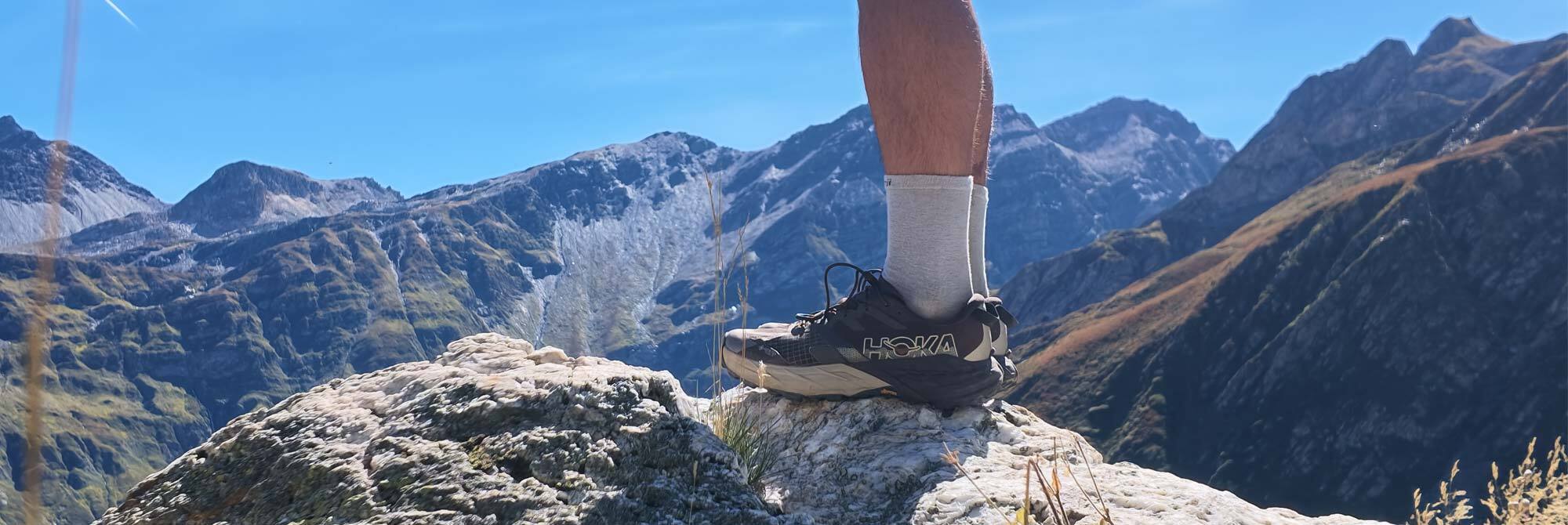
Recently, I got the chance to test the Hoka Speedgoat 7 GTX over 110 miles of mixed terrain on Tour du Mont Blanc (TMB), covering long days on rocky, technical trails with plenty of climbing, scrambling and descents – and from what I could see, I wasn’t the only one – the Speedgoat was probably the most spotted shoe on foot on the TMB.
I flew to Geneva the same week the Speedgoat 7 GTX released, so apart from a few days wearing them around the office, I had no real opportunity to wear them in. Not ideal, but they felt comfortable straight out of the box, and I had allowed myself some extra room by going up half a size to my normal shoe size, which I have found has become the norm with all Hoka footwear.
I opted for the Gore-Tex model, for no other reason than I preferred the colourway options and the upper design from a stylistic point of view. That being said, the Speedgoat 7 GTX is made up of more durable materials than its non-Gore namesake, featuring a Cordura Ripstop upper and a more prominent toe-guard which I felt would be more suited to meet the demands of the mixed terrain on Tour du Mont Blanc.
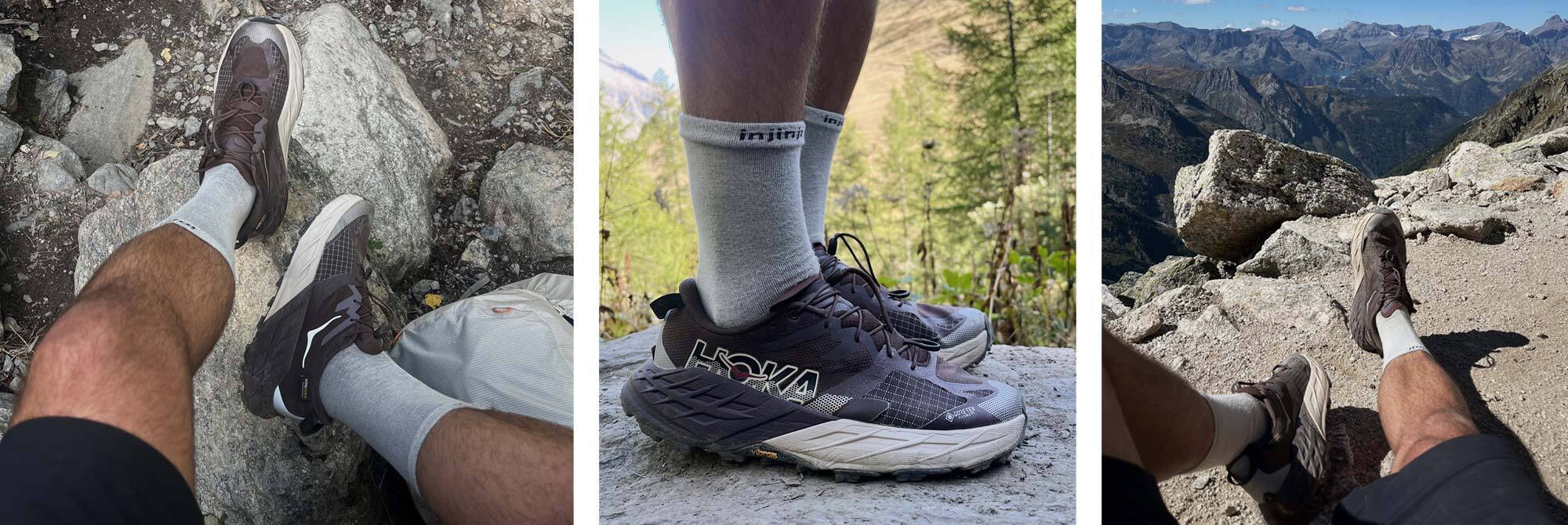
The Speedgoat 7 GTX has the familiar cushion and high-stack feel that Hoka is renowned for. Paired with some Injinji Toe Socks, the shoes felt comfortable and plush, without compromising stability on technical terrain. I have suffered with toe blisters on previous long-distance hikes and I am glad to report ZERO blisters after 12 days and 110+ miles of hiking in (mostly) warm conditions, nor did I feel as though my feet were overheating in any capacity, which is often the worry when using Gore-Tex footwear.
The cushioning really came into its own later in the day. After several hours of hiking with a fully loaded pack, my feet still felt relatively fresh, and the shoes did a good job of taking the sting out of rocky descents and hard-packed sections. Probably the biggest endorsement of this shoe is the fact that I looked-forward to putting them on every morning, which is not always the case on some multi-day hikes.
For the first time, Hoka have opted for a “Toggle” lacing system (standard laces also included), which is a no-tie fastening system that uses an elastic cord and a spring-loaded plastic stopper (the toggle) to secure shoes without traditional knots. This was very welcome on long descents, where I could loosen off the “laces” to allow for a little more movement and comfort when my feet were generally pushed towards the front of the shoe. This also allowed me to freely slip my shoes on and off quickly, to remove small debris on the loose and rocky sections.
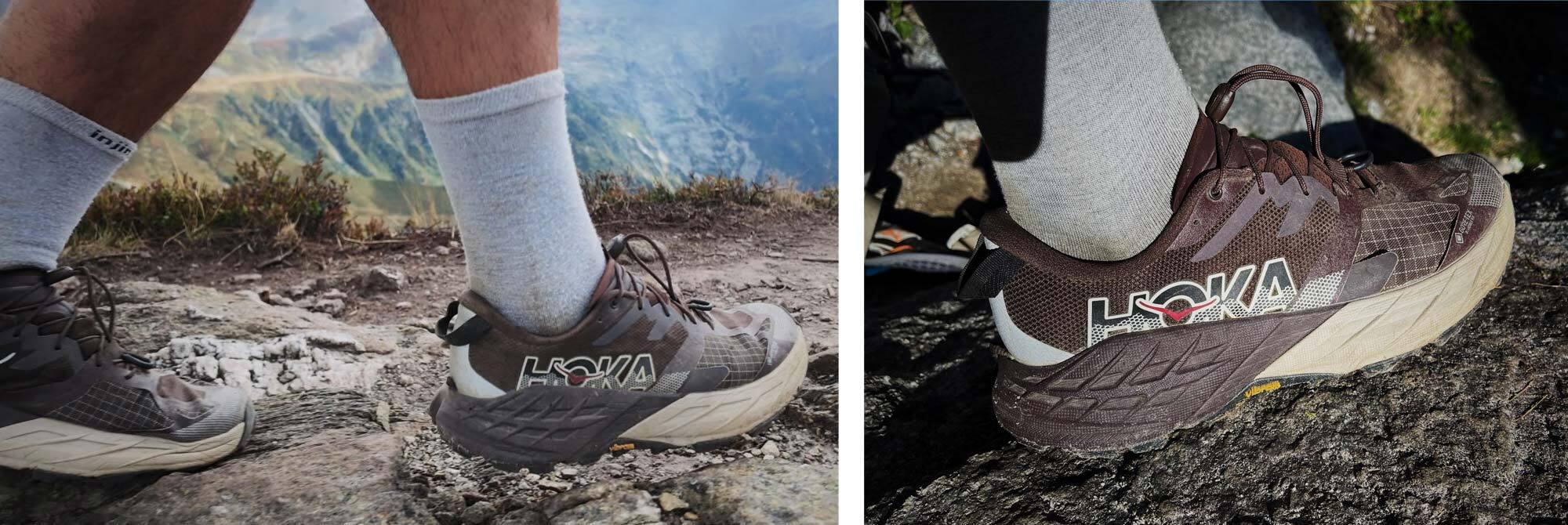
My feet did get wet on one particular day, when we had non-stop torrential rain for hours on end. This would most likely have soaked even the most water-tight of shoes. This was inevitable as I chose to wear a low-profile shoe, with shorts and no gaiters – my own fault. What did surprise me, was just how fast the shoes dried. By the next morning, the shoes had pretty much dried out and were ready to go again.
It wasn’t all plain sailing, unfortunately. Very early into the trip (<10k) I noticed some of the decorative overlays on the toe-box had already started to lift. This did not affect the performance of the shoe whatsoever, but it did make the shoes look much more worn than they actually were. They had started to lift on the part of the toe-box which flexes as you walk, which could have been compounded by going up half a size.
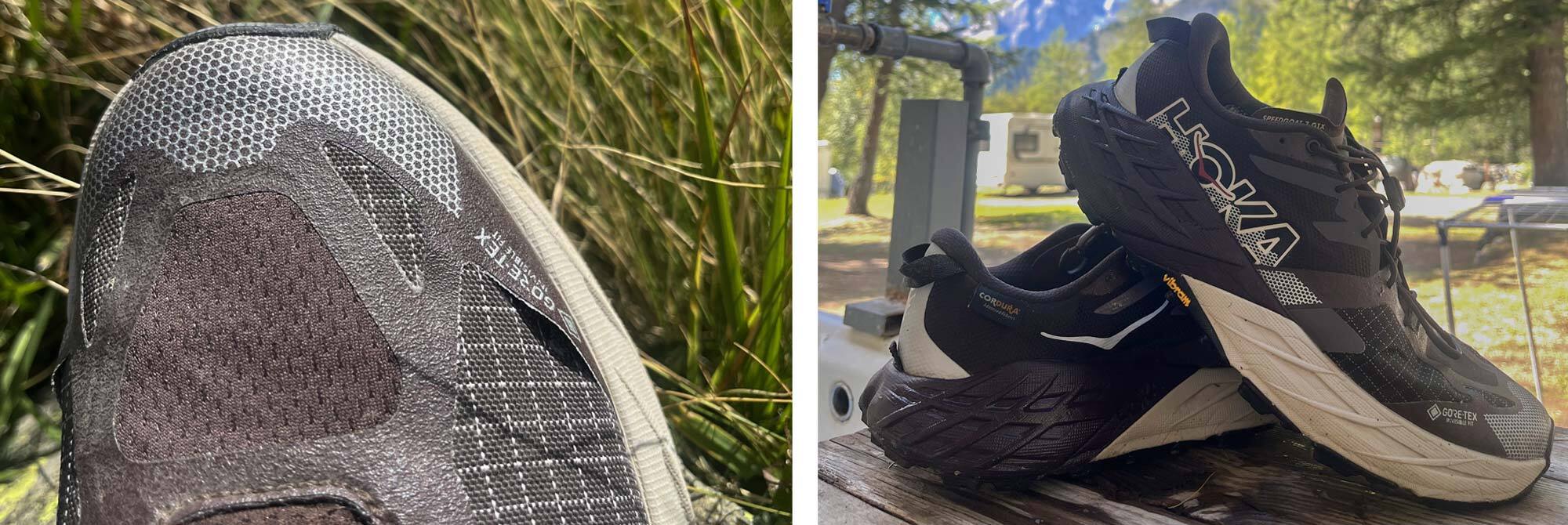
The standout feature for me was the grip. The Vibram Megagrip performed exceptionally, with the help from the Traction lug pattern, they gripped to wet rock with ease and quickly gained my trust on the most technical terrain. It was also noticeable just how little degradation could be seen on the lug, after a combined 170km of walking and 22,000 metres of ascent & descent. Previously, Hokas durability could be questioned, particularly where glue would fail on the outsole – they seem to have fixed this problem with this iteration of the Speedgoat, but only time will tell as Hoka expect the lifespan of these shoes to typically last anywhere between 300 and 500 miles.
Overall, I’ve really enjoyed wearing these shoes day-after-day. They offer a great balance of comfort, grip and stability and not to mention they look great at the same time. While there are always a few minor compromises, the positives far outweigh the negatives and I’d be happy to recommend these shoes to anyone looking for a dependable pair of trail runners. I’m looking forward to many more miles in these shoes, both hiking and running on my local trails.
 |
||
 |
||
| Mathew Garbutt | ||
|
Mathew is an avid sports fan who plays football semi-professionally for a local team. As a child, Mathew and his family would Car Camp in the Lake District regularly, which is a tradition he has passed-on to his own young family. He is a strong advocate for the outdoors and the importance of his children being outside and exploring the many wonderful places on offer around the North-East and beyond. It was through working at Ultralight where Mathews love for the outdoors and particularly wild camping flourished, taking up many of the opportunities presented to him through his work. Trips to Scotland are a regular occurrence, from taking-in Munros to the snow-capped mountains of the Cairngorms for winter-skills training. More recently, Mathew has re-found his love for running and particularly enjoys meeting with a group of friends on a Sunday morning trail run. Mathew joined UOG in 2017 and is a Purchasing Assistant in our Buying Team. |
||