Primus Micron III Piezo Stove & Trek Pot Set Review - ''Compact, functional, versatile, and capable, with just enough compromises to remind you it’s still built for people who care about grams.''
Posted by Andy Neil on Dec 04, 2025
The Primus Micron III Piezo Stove and Trek Pot Set offer an appealing option for anyone wanting a compact setup that still lets you cook proper food in the hills. They sit in that interesting spot between ultra-minimal “boil water only” systems and heavier cookware that leans more towards basecamp or group cooking. Both items work perfectly well on their own, but I’ve been using them as a paired setup, which has given me a good sense of how they perform individually and together as a lightweight cooking system.
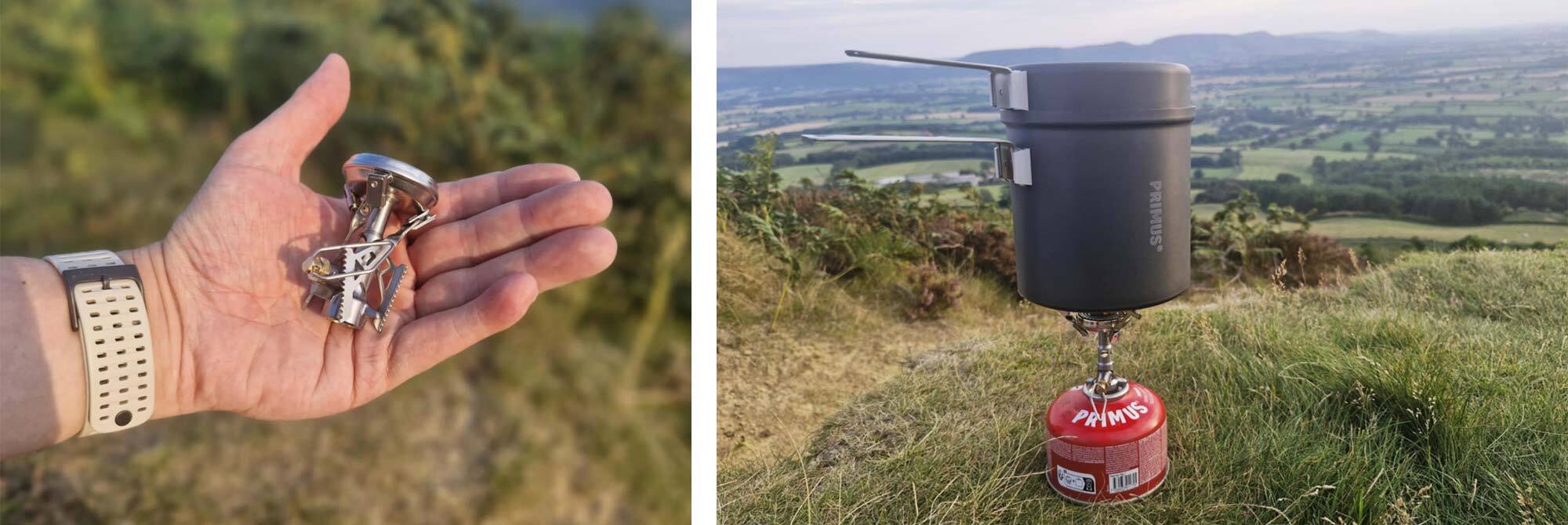
Starting with the Micron III Piezo, the stove folds down very compactly and weighs around 56 grams. When packed, it fits neatly inside the 1-litre pot alongside a small gas canister, though the whole set only nests cleanly if you leave the 0.6-litre pot at home. A larger 230g canister fits as well on the same basis. I’ve been repurposing the mesh bag from the smaller pot to house the gas canister, which prevents the metal from scuffing the ceramic coating and keeps the contents snug in transit. Setup is as straightforward as you’d expect from a minimalist canister stove: unfold the supports, screw it onto a standard threaded gas canister, and you’re cooking within seconds.
Output is impressive for a burner of this size: a tight, high-speed flame that quickly and quietly boils water and pairs naturally with narrower pots. More importantly, the oversized control valve gives far better simmer control than most stoves in this weight class. When I cooked on it, I could drop the flame right down and hold a gentle simmer without everything jumping from “barely on” to blowtorch. In terms of fuel use, I’d call it average to slightly better than most micro burners I’ve used, and pairing it with a pot that suits its focused flame further improves efficiency. As with most canister stoves, it’s best not to run it flat-out; backing the flame off slightly doesn’t speed anything up, but it does noticeably extend a canister on longer trips.
The most apparent drawback is in the name: “Piezo”, which, to me, implies built-in ignition, and here that is not the case. Primus supplies a “matchstick-style Piezo igniter”, and while it works well, it’s still another small bit of kit to keep track of. I’d much rather the ignition be integrated into the stove body. Some will appreciate the stripped-back design, but I’d rather not carry anything extra that could be lost, so I’ll just continue to bring a lighter.
The other issue I ran into was during cooking: one of the pot supports folded down. It’s only happened once and hasn't happened again, although I did have a separate instance where the same support jammed in the folded position and required a bit of wrestling to get upright again. However, every other time I have used it, the supports have felt solid, especially with cookware that suits this type of burner. It’s worth noting because it did happen.
Wind resistance is about what you’d expect. It’s perfectly capable in calm to moderate wind, and will boil fast. Expose it to a strong breeze, and you need to shield it; otherwise, efficiency drops. Anyone who’s used lightweight canister stoves already knows the routine: find cover, angle the pot, or bring a small wind shield.
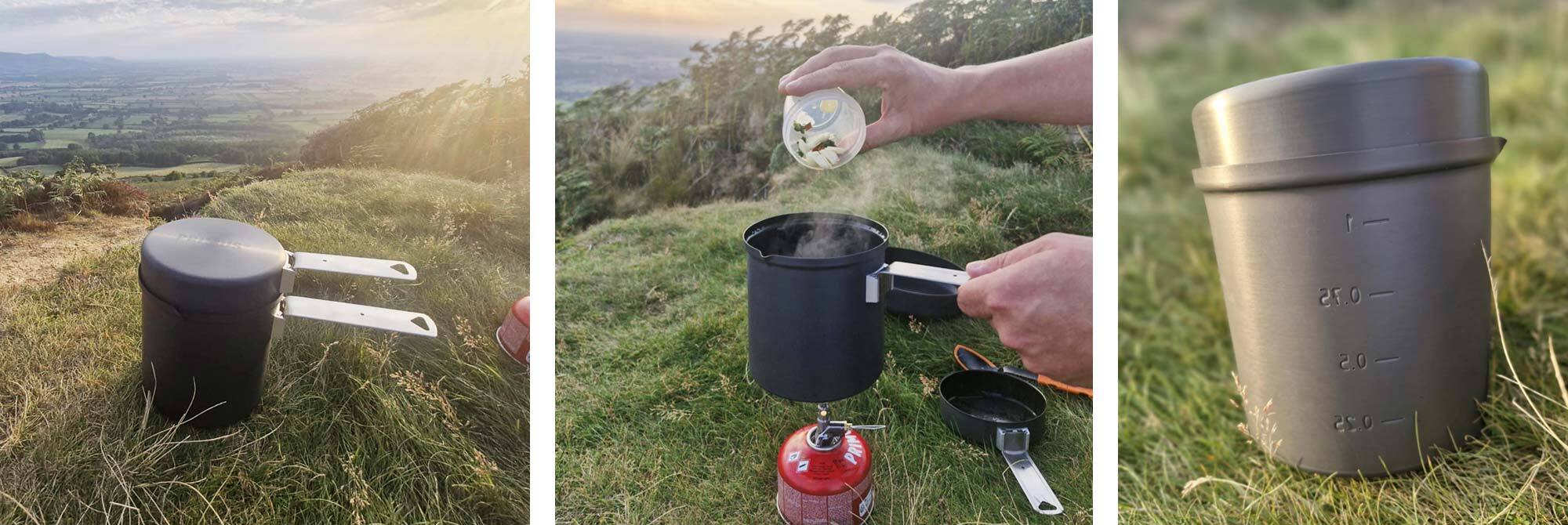
Where things get more interesting is with the Trek Pot Set. It includes a 1-litre pot (247g, with lid), a 0.6-litre pot (138g), a small frying pan that doubles as a lid for the larger pot, and three removable handles. The whole set is hard-anodised aluminium with a ceramic non-stick coating, and the bases are noticeably thicker than most lightweight backpacking pots. Unlike many ultralight cooking pots that favour a broader base, the Trek pots are narrower and closer in shape to traditional backcountry cookware. That slimmer profile packs more neatly in a rucksack and pairs better with small canister burners that produce a tighter, more focused flame. Heat spreads well, simmering doesn’t instantly burn food, and cleanup is straightforward even after cooking something messy.
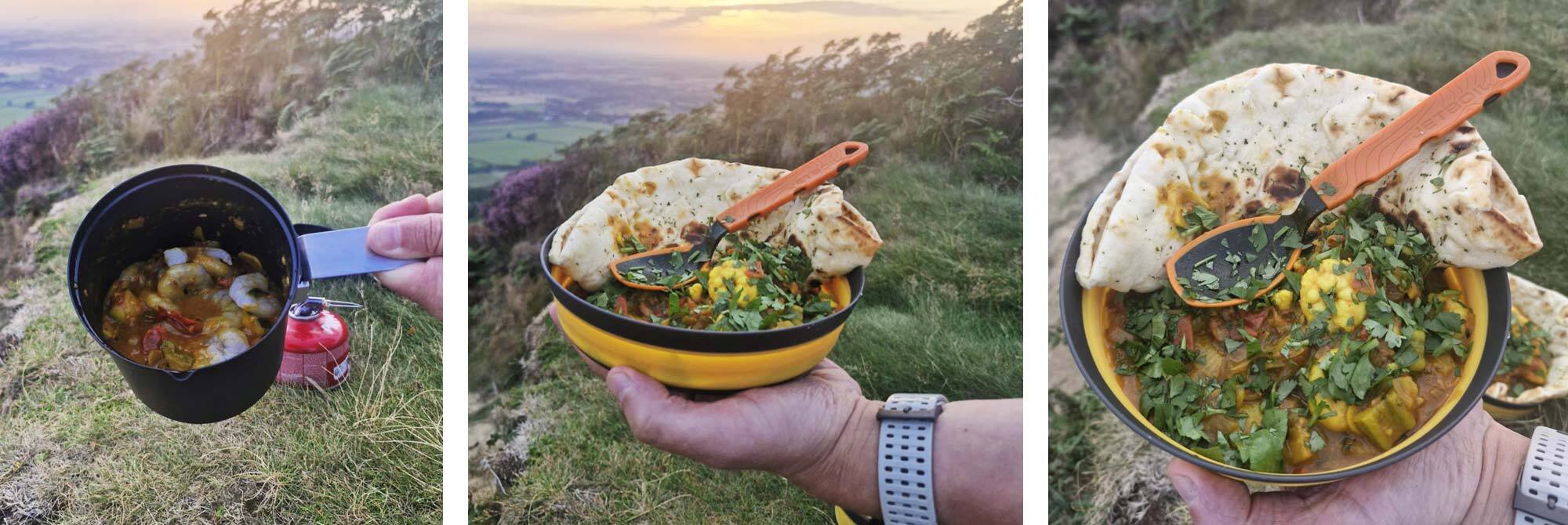
To give it a fair test, I cooked a prawn curry in the 1-litre pot. I wanted to see how evenly it heated, how easy it was to keep food moving in a relatively compact pot, and how well the Micron III could hold a controlled flame underneath it. It passed on all counts. The thicker base and the stove’s ability to hold a low flame meant I could keep it simmering without burning, which is exactly what you want when cooking something more involved than a dehydrated meal.
The 0.6-litre pot, however, is ideal for dehydrated meals, drinks, or solo use, while the 1-litre pot gives enough capacity to feed two. The frying pan is mainly a lid, but it can handle small portions, an egg, a strip or two of bacon, maybe a quick fry-off of some spices before they head into a sauce. Anyone expecting a full English from it will be disappointed, but compared with most “pan-as-lid” designs, it’s more capable, primarily because of its non-stick surface.
Primus includes three removable handles. I can’t imagine needing all three at once, but it’s better than being short, and one of them also locks the set closed in transit. They’re a little fiddly to attach and remove, especially when hot, yet the overall nesting is clean and quiet with very little rattle. At just under 400g for the whole set, it’s not the lightest option, but for a ceramic-coated system that actually lets you cook, it’s competitive. The real appeal is the flexibility: you don’t have to take everything. The 0.6-litre pot on its own is ideal for dehydrated meals or fast solo trips, while the full set opens up proper two-person cooking and lets you boil, fry, and strain. In that sense, it’s essentially two setups in one, letting you go lean when speed matters or carry the whole system when you want to cook properly.
As a full system, the Micron III and Trek Pot Set work well. The stove sits inside the 1-litre pot (I’d keep it in its storage pouch to protect the coating), and everything packs tighter than you’d expect for a setup that genuinely lets you cook a meal. It’s not for the titanium mug minimalists, and it’s not for people cooking group banquets either. But for fast-moving trips where pack space and weight matter, and where a proper hot meal makes the evening, this pairing hits a sweet middle ground. Compact, functional, versatile, and capable, with just enough compromises to remind you it’s still built for people who care about grams.
 |
||
 |
||
| Andy Neil |
||
|
Andy has been a keen long-distance hiker and wild camping enthusiast since he completed the Cleveland Way in 2015. Since then, he has walked thousands of trail miles all over the UK and is an active member of the Wild Camping UK community, being an admin of the largest wild camping community on Facebook. He strongly advocates for responsible wild camping and believes it is important to leave no trace when camping in the wilderness. He joined the UOG team in 2021 and works as a website developer and content creator. |
||